
Valentino Classic Handbags Valentino Tote Bag
Valentino Purses On Their Way Out of the Collection: Roman Stud, One Stud, Supervee and Escape
Hardly any label publishes a statement when a handbag range is retired. It begins when the filters quietly lose the style, next availability shrinks, the product pages remain lit like lights left on in an empty house, and one morning only resale platforms still have it. At Valentino, the Roman Stud, One Stud, Supervee, Escape and Stud Sign now sit in broadly that position, a house that took a new creative direction with Alessandro Michele’s arrival in 2024, taking over from Pierpaolo Piccioli, and that registered the death of its founder Valentino Garavani on 19 January 2026, aged 93. He had retired from design in 2007 and sold the company in 1998, so these bags were never his work, yet the slow retreat of a signature motif still lands as a quiet ending. Read on for what has gone from the collection, what the remainders go for and what to inspect before a second-hand purchase. Nothing here is an official price list: the money quoted is an observed 2026 market price.
The tell-tale signs of a line being retired
Rumour has nothing to do with it, because a dependable test exists. The exercise is simple: compare the line filters on the brand’s own site with the product pages search engines still surface: filters reveal what the house currently sells, pages show what lingers in the system. The current filters, as of September 2026, list Alltime, Antibes, Carry Secrets, DeVain, Djuna, Flutterby, Laseine, Locò, Nellcote, Panthea, Rockstud, Rockstud Spike, Vain, VLogo Signature and VSling. Roman Stud, One Stud, Supervee, Escape and Stud Sign show up in none of them. Nothing indicates a line on its way out more reliably than a style missing from the filters whose page still opens. The Rockstud motif — it arrived in Fall 2010 on footwear under then co-creative directors Maria Grazia Chiuri and Pierpaolo Piccioli — remains central to the collection, so this is a trim rather than any kind of reset.
Roman Stud: the line that has not fully left
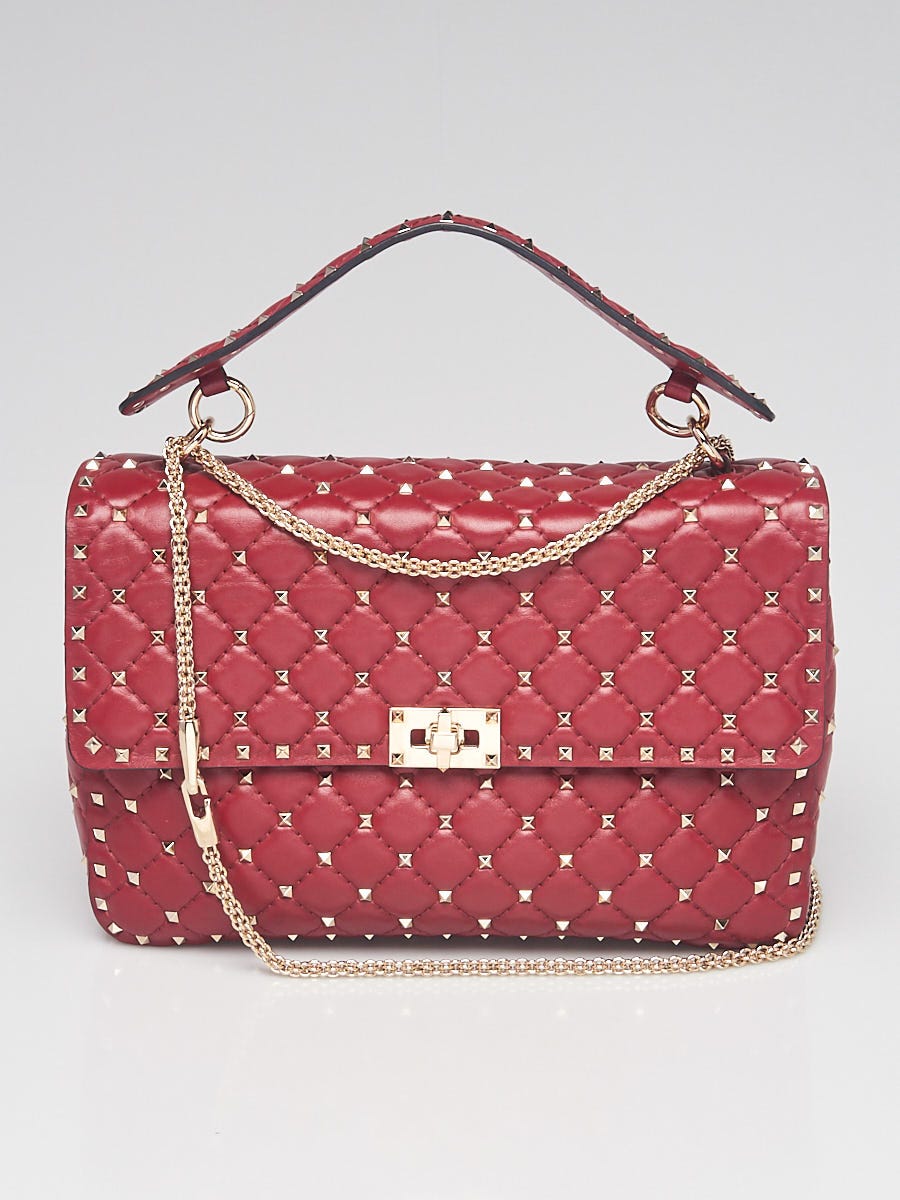
The Roman Stud rewards a closer look, because it has not fully gone. Nobody could mistake the design: chevron and rhombus quilting in nappa, tone-on-tone stitching, and maxi pyramid studs set valentino tote sale into the quilt lines. It is absent from the current filters, yet product pages persist, and one observed example makes the point better than any announcement. Take a small Roman Stud Handle Bag in denim, 21 by 17 by 14 centimetres, with argyle quilting, antique-brass studs, a front twist-lock and rear magnetic closure, made in Italy — it was listed at 3,550 dollars, marked as a reserved product rather than orderable. That is a line caught mid-exit: visible, priced, describable and unavailable. In practice the secondary market is where you will find a Roman Stud, so read the line as transitional.
One Stud: stripped to a single gesture
The One Stud answers the Roman Stud, trading multiplied hardware for a single oversized stud, and that restraint is the idea. Like the others, it is absent from the current filters, so it belongs in the archive column. A large One Stud tote in nappa was observed at about 1,695 dollars through a third-party retailer, not the house, a helpful reminder that a live listing does not prove current production. Retailer stock can survive a line by a season and is cleared at whatever price the retailer chooses. On purpose, no launch year is stated: the dates doing the rounds for this model trace back to a single unverified source, and a guess presented as fact helps nobody. The shape does read quieter than most Valentino bags, and that is exactly why some buyers hunt for it.
Supervee: resale only, and traded thinly
The V emblem works as the structural event on the front of the Supervee rather than a small badge, which puts it squarely in the VLogo family. In contrast to the Roman Stud, it has no halfway status — it has gone from the collection entirely. One pre-owned VLogo Supervee shoulder bag was observed at around 866 dollars, exactly the kind of figure that tempts people to read one listing as a market rate. A single listing is no market rate. Condition, colour, finish and seller patience can push the next example hundreds of dollars in either direction when a style trades this thinly. Anyone hunting an archive valentino shoulder bag should follow a few platforms for weeks and build a range first.
Escape: said to be gone
The VLogo Escape tote allows the least doubt of the five: a resale platform has reported it discontinued outright. The build is easy to spot: hammered and quilted leather, double top handles, a removable shoulder strap and gold-tone hardware, constructed as a working tote, rather than an occasion piece. Because practical bags get used rather than stored, the second-hand supply reflects that. More wear shows at the handle roots and base corners than on an evening style of the same age. Current VLogo Signature shopping bags were observed between 2,650 and 3,750 dollars, so as a discontinued valentino tote bag it is worth it only at a genuinely attractive price. Assess each example on its condition rather than the model’s reputation.
Stud Sign, and the borderline names
The Garavani Stud Sign shows up as a named product, most visibly a Stud Sign VLogo leather shoulder bag, yet the current filters omit it. It sits in archive or clearing rather than active, turning up sporadically at retailers working through remaining stock. Because it could not be verified as part of the current collection, the Candystud — named repeatedly in resale commentary as a house classic — sits in the unresolved column. At the edges of a large catalogue, capsules, regional exclusives and retailer stock smudge the boundary between current and archive, so ambiguity of this sort is normal. Anything missing from the brand’s own filters should be handled as a secondary-market purchase, and that is the honest reading. If a seller says different, ask them to show where it sits in the current collection.
What the archive really costs
There are two price sources for these bags, and mixing them up ends in bad decisions. Leftover new stock is priced by the retailer, not by any official valentino bag sale, and can sit well above or below the pre-owned figure. Condition and completeness determine secondary-market pricing, and in thin markets prices jump unpredictably between listings. The one piece of hard data available is retention, and it flatters this group: Rebag’s figures put the Roman Stud Flap at 58 percent of original retail, the strongest result in the range, against a house average of 41 percent for Valentino handbags in 2023. Read it as observed market behaviour rather than a promise: secondary prices can go down. Each line’s status and the figures observed for it are summarised in the table below.
| Model line | Present status | Observed figure |
|---|---|---|
| Roman Stud | Winding down; not in the filters, product pages remain | Denim Handle Bag at $3,550, flagged reserved and not orderable; flap style holds 58% retention |
| One Stud | Archive; dropped from the filters | Large nappa tote about $1,695, third-party retailer |
| Supervee | Resale channels only | VLogo shoulder bag about $866 pre-owned |
| Escape | A resale platform reports it discontinued | No current price verified |
| Stud Sign | Archive; not in the filters | Current price unverified |
Buying from the archive without regret
Before anything else, confirm which company made the bag: Mario Valentino S.p.A. is a separate and unrelated business whose products also sell under a Valentino name. On a bag from the luxury house, an interior tag reads VALENTINO and GARAVANI in capitals with MADE IN ITALY, sewn on all four sides, evenly stamped and unsmudged. Most bags carry a serial number on a tag inside an interior pocket, although some do not, older models may carry none, and its absence proves nothing about authenticity. There is no date-code system here to decode, so pay no attention to anyone claiming to read a manufacturing date from the numbers. Check stud seating, plating wear at the base corners, the action of any twist-lock and whether the lining has been cleaned or replaced with archive pieces. Demand photographs of the tag, base, hardware underside and strap attachments before any money changes hands.
What it really means when a line disappears
Nothing here makes an archive valentino bag a worse object than it was last season. Because lines are cut for commercial reasons, a bag no longer matching the current direction is still beautifully made, with the Italian construction it had. In practice the effects are limited: no new colours or seasonal materials, no guaranteed boutique repairs indefinitely, and a slow drift in how recognisable the design feels. Set that against the fact that an archive valentino garavani bag typically costs less than the current-collection equivalent and is far rarer on the street. For a buyer who cares about secondary-market strength, the Roman Stud flap stands out. If you simply want the bag, find the best condition you can and buy from a seller who shows you everything, and stop worrying about what the filters say.
Leave a Reply